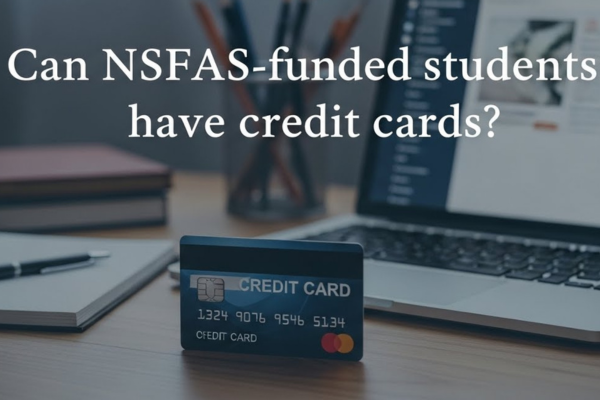
Can NSFAS-funded students have credit cards?
There is no administrative regulation within the funding scheme that prohibits a student from holding a credit card.
However, the ability to obtain one is governed entirely by national credit legislation and the internal risk assessments of commercial banks.
For a student receiving a monthly allowance, a credit card is often used as a tool to build a credit score, which is essential for future financial milestones like vehicle financing or home loans.
However, because the bursary allowance is a temporary grant rather than a permanent salary, approval is not guaranteed.
Step 1: Understanding Credit Provider Requirements
Commercial banks evaluate applicants based on “affordability.” Since a student’s primary “income” is the monthly personal care allowance, the bank will look for the following technical criteria:
- Age: The applicant must be at least 18 years old.
- Stable Inflow: Regular monthly deposits (such as the bursary allowance) into a bank account.
- FICA Compliance: Valid proof of residence and a South African identity document.
- Credit History: If the student has no previous credit history, the bank may start them with a very low credit limit to monitor repayment behavior.
Step 2: Banks Offering Student Credit Products and Benefits
Most major commercial banks offer specialized accounts that can include credit facilities. These products are tailored with lower income requirements compared to professional credit cards.
Standard Bank – Student Achiever Account
- Includes a low-limit credit card option specifically for students.
- Provides access to exclusive student deals and travel discounts.
- Offers reduced monthly service fees for those under 24.
Absa – Student Silver Account
- Zero monthly maintenance fees for qualifying students.
- Access to the Absa Rewards program.
- Credit facilities are available subject to an affordability assessment of monthly inflows.
FNB – FNBy Account
- Discounted monthly fees and free electronic transactions.
- Earn “eBucks” rewards for spending at selected retailers.
- Offers credit card options for students with consistent monthly allowance deposits.
Nedbank – Unlocked Account
- Zero monthly maintenance fees.
- Includes lifestyle vouchers, such as food or data discounts, for active accounts.
- Specialized credit entry-level options for students.
Capitec – Global One Account
- While not a “student-only” card, it offers a credit facility with a low entry barrier.
- Based on consistent monthly deposits, making it accessible for bursary recipients.
- Offers some of the lowest transaction fees in the commercial market.
Step 3: The Impact of Monthly Allowances on Approval
Banks generally require a minimum monthly income to approve a credit card. For students, the Living Allowance (approximately R1,650 per month) is considered a valid “inflow,” but it often falls below the minimum threshold for standard professional credit cards.
Students have a higher probability of approval if they apply for a Student-Specific Credit Card, which recognizes bursary inflows as a valid form of sustenance. If a student has a part-time job or stipend alongside their bursary, this must be declared to improve the affordability score.
Step 4: Managing the Credit Limit vs. Allowance
If a student is approved for a credit card, the limit is typically conservative (e.g., R500 to R2,000).
It is technically vital to ensure that credit card repayments do not exceed the monthly personal care allowance. If a student fails to make a payment because a bursary disbursement was delayed, it will result in a negative credit report. This “black mark” can stay on a student’s profile for years, potentially affecting their employability in the financial or legal sectors after graduation.
Step 5: Differentiating Between Debit and Credit Cards
It is important to clarify the technical difference between the cards used by students:
- NSFAS Card / Student Debit Card: Uses money already available in the account. There is no risk of debt or interest charges.
- Credit Card: Uses money borrowed from a bank. It requires monthly repayments and accumulates interest if the balance is not cleared.
Students are advised to use credit cards primarily for building a credit history by making small, manageable purchases—like data or groceries—and paying them off in full every month using their allowance.