What documents do I need to submit to a SARS tax return?
Accurate tax filing depends on verifiable documentation.
Choose one option to continue:
💰 Check If SARS Owes Me Money ♻️📊 Qualify For SARS Tax Return ⚠️ If I Owe SARS Money HelpWhether you are a student ensuring your household information aligns with NSFAS requirements or an individual seeking to maximise a legitimate refund, supporting documents play a critical role in validating your return.
Incomplete or incorrect documentation is one of the most common reasons for audits, verification delays, or rejected claims.
This guide outlines the key documents required to submit a complete and compliant tax return and explains how each category supports the accuracy of your submission.
Phase 1: Core Identity and Income Documentation
Every tax return begins with confirming your identity and income sources. Without these documents, the filing process cannot proceed beyond the initial stages.
1. Personal Identification and Banking Details
You must have a valid identification document, such as an ID card or equivalent official identification, available when filing.
Equally important is proof of banking details. This is usually a bank-stamped letter or recent bank statement issued within the last three months. The information must clearly display your name, account number, and bank details.
It is essential that your banking information matches your identification details exactly. Any discrepancy between your tax profile, identification, and bank account may result in delayed refunds or rejected verification requests.
2. Income Certificates (IRP5 / IT3(a))
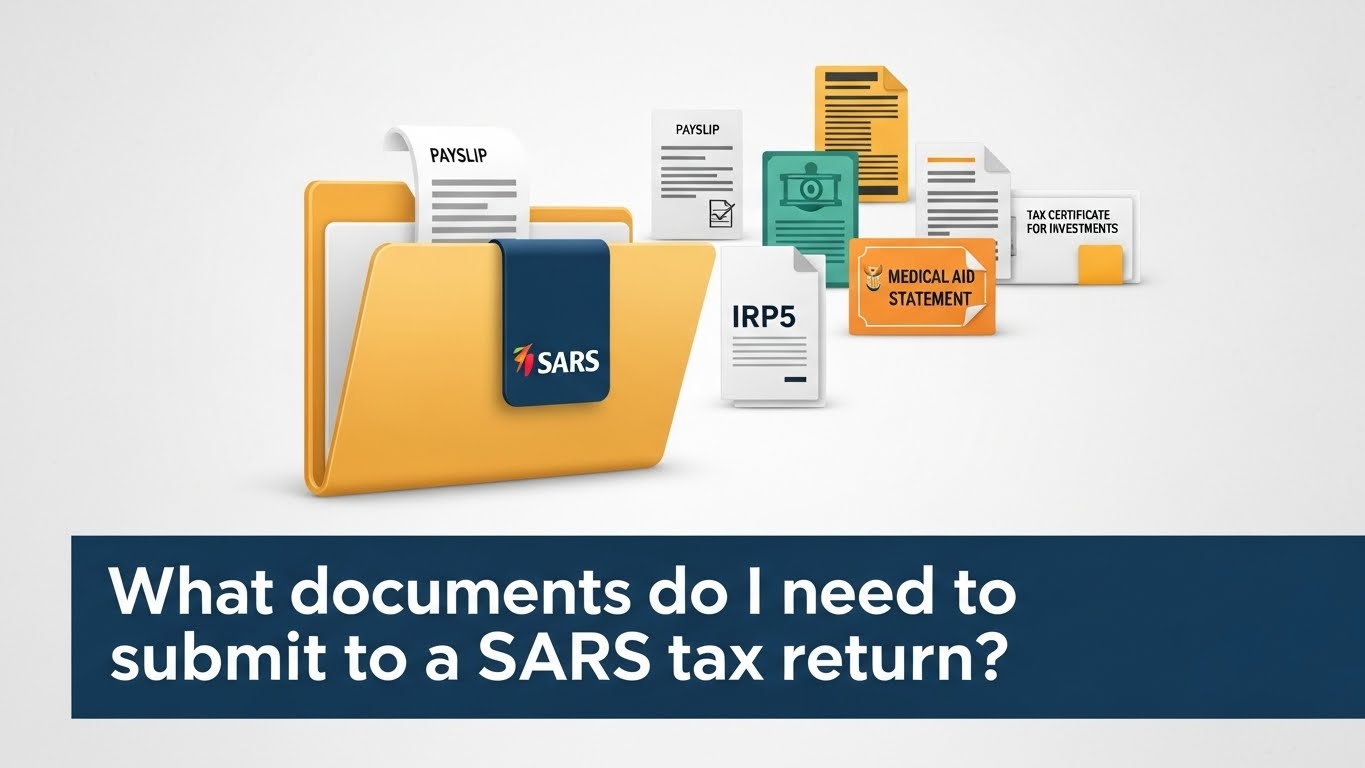
For individuals who earn employment income, the IRP5 or IT3(a) certificate is a mandatory document. It provides a summary of your income, tax deducted, and applicable tax codes for the assessment period.
Although employers often submit this information directly to the tax authority, you should retain a copy for verification purposes. Review the certificate carefully to confirm that income figures, tax codes, and employment periods are correct. Errors at this stage can lead to incorrect assessments or underpayment notices.
Phase 2: Deduction and Allowance Documentation
Supporting documents are also required to substantiate deductions and tax-free allowances claimed on your return.
3. Medical Scheme and Medical Expense Records
If you belong to a medical scheme, you will need an annual medical tax certificate showing monthly contributions and registered dependants.
In addition, retain receipts and invoices for qualifying medical expenses not covered by the scheme, such as prescription medication or specialist treatments. These documents may be requested during verification and can affect the final tax calculation.
Unclaimed or undocumented medical expenses cannot be allowed, even if they were legitimately incurred.
4. Retirement Fund Contribution Certificates
Contributions to approved retirement funds may qualify for tax deductions. These are supported by IT3(f) certificates issued by retirement annuity providers, pension funds, or insurance companies.
These certificates confirm total contributions made during the tax year and are required to validate any deduction claimed. Missing or incorrect certificates may result in disallowed deductions.
Phase 3: Investment, Travel, and Home Office Documentation
Taxpayers with additional income sources or specific expense claims must maintain further records.
5. Investment Income Certificates (IT3(b) and IT3(c))
If you earned interest, dividends, or capital gains, you must retain the relevant investment certificates issued by banks or investment platforms.
- IT3(b) certificates reflect interest and dividend income.
- IT3(c) certificates reflect capital gains or losses from asset disposals.
These documents ensure that investment income is correctly declared and assessed.
6. Travel and Home Office Records
If you receive a travel allowance, a detailed logbook is mandatory. The logbook must record opening and closing odometer readings and distinguish between business and private travel.
For home office claims, you must retain a floor plan indicating the workspace area, along with records of household expenses such as utilities, connectivity, and rent or bond interest. These expenses must be apportioned accurately.
Without these records, related claims are likely to be disallowed during verification or audit.
Phase 4: Verification and Record Retention
Submitting a return does not eliminate the requirement to retain documentation.
7. Uploading Supporting Documents
If your return is selected for verification, you will be required to upload supporting documents electronically. Documents should be clear, legible PDF files and appropriately named to reflect their contents.
Clear file naming and document quality can significantly reduce verification turnaround times.
8. NSFAS Data Alignment
For students and parents, tax documentation is often used to verify household income for NSFAS applications. Consistent and accurate tax records reduce the risk of income mismatches that may delay or compromise funding decisions.
Summary
Successful tax filing is built on preparation and documentation. By collecting income certificates, medical records, investment statements, and expense logs before filing, you reduce errors and minimise the risk of audits or delays.
Maintaining organised records ensures that your tax return is processed efficiently and that any refunds or benefits are released without unnecessary administrative obstacles.