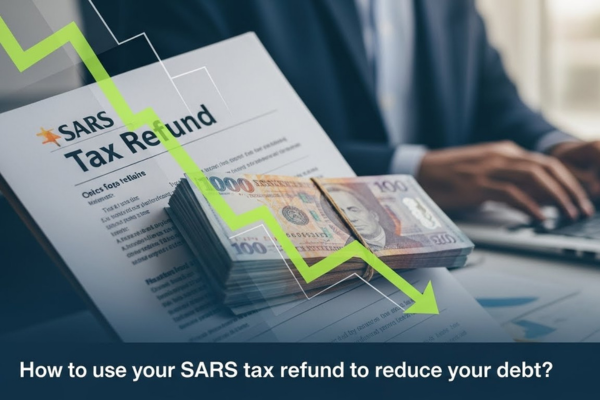
How to use your SARS tax refund to reduce your debt?
A tax refund is often viewed as unexpected income, but the most strategic taxpayers understand that it can serve as a financial lever.
By directing an overpayment to settle an existing debt, you can improve your compliance status, reduce interest costs, and accelerate your financial stability. This process, often called Debt Equalization, transforms passive refunds into active capital allocation.
This guide provides a professional roadmap for using your refund to clear obligations, optimize repayment strategies, and verify your compliance status.
Phase 1: Automated Debt Equalization (The Set-Off)
The revenue system is equipped with an automated mechanism known as a Set-Off. When both a refund and an outstanding debt exist on your profile, the system may allocate the credit automatically.
1. Understanding Automated Offsets
The system can apply a credit from one tax type (for example, personal income tax) toward a debt in another category (such as administrative penalties or value-added tax).
- Process: During the assessment phase, the portal will generate a line item labeled “Journal Credit/Debit” or “Set-Off” on your Statement of Account (ITSA).
- Outcome: Your refund is reduced by the debt amount, and only the net balance is disbursed to your bank account.
Key Insight: Automated offsets ensure the system settles outstanding obligations before releasing funds to you, preventing further accumulation of penalties or interest.
Phase 2: Manual Allocation of Overpayments
If the system does not automatically offset your debt—often because it resides in a separate “tax folder”—you must proactively request a transfer of credits.
2. Requesting a Transfer
When you have a credit on your income tax account but owe money in another category, a manual allocation can prevent further interest accumulation.
- Action: Submit a formal request via the portal’s Account Enquiries tab or through a registered tax practitioner.
- Requirement: Include a signed letter specifying the source account (where the refund is located) and the destination account (where the debt should be applied).
Expert Tip: Manual allocation ensures that your outstanding obligations are settled promptly while waiting for the standard refund cycle.
Phase 3: External Debt Reduction Strategy
For taxpayers with no government debt but carrying high-interest private debt, a refund is the most powerful repayment accelerator.
3. The “Highest Interest First” Rule
To maximize the value of a refund, prioritize debt repayment based on interest rates.
- Action: Identify the obligation with the highest annual percentage rate (APR), typically a credit card or store account.
- Math: Applying R5,000 toward a 24% APR credit card yields more savings than paying the same amount toward a 7% auto loan.
Soundbite: Eliminating the most expensive debt first maximizes long-term financial efficiency.
4. Reinvesting in Retirement (The Double Refund Strategy)
An advanced strategy involves reinvesting your refund into a Retirement Annuity (RA).
- The Loop: Contributions to an RA are tax-deductible, which may generate another refund in the following tax year.
- Outcome: This creates a continuous cycle of debt reduction and wealth accumulation, while enhancing long-term financial security.
Phase 4: Validating the “Clean Slate”
After using your refund to settle debt, confirm that the system recognizes your updated status.
5. Checking Your Compliance Profile
- Step: Navigate to “My Compliance Profile” on the portal.
- Goal: Ensure that the “Outstanding Debt” indicator has changed from a Red Cross to a Green Checkmark.
- Insight: Only a green status allows you to generate a Tax Compliance Status (TCS) PIN, which is required for funding, employment, or business verification.
Professional Summary
A refund should never be treated as discretionary income alone. Using it to offset debt is a defensive-offensive strategy that stops interest from compounding, restores compliance, and builds financial credibility. Whether through automated set-offs or targeted private debt repayment, strategic allocation transforms a simple overpayment into a powerful tool for financial restructuring.
Soundbite: Treat every refund as an opportunity to eliminate liabilities and reinforce both compliance and financial stability.