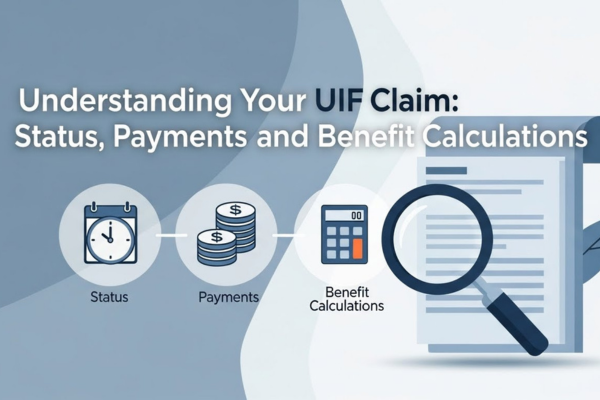
Understanding Your UIF Claim: Status, Payments, and Benefit Calculations
When a UIF claim is delayed, the impact is not only administrative — it affects financial planning, household stability, and personal confidence.
Choose one option to continue:
🔍 UIF Status Check Online ⏱️ See Your Payout Timeline 💰 Calculate Your UIF PayoutMost claimants are not simply checking a “status”; they are trying to determine whether their income interruption will be resolved, and when.
Through years of assisting workers with UIF-related processes, one consistent issue stands out: the system communicates in technical statuses and internal processes that are not intuitive to the average user.
As a result, many claimants monitor the portal repeatedly without understanding what the information actually means or what actions, if any, are required.
This guide addresses three critical questions that determine whether a UIF claim progresses efficiently or remains stalled indefinitely.
1. How to Check Your UIF Status Correctly
Checking your UIF status online is the first step, but it is often misunderstood.
The portal is a legacy system that relies on multiple back-end validations. A “Pending” status does not always mean that the system is waiting for internal processing.
In many cases, it indicates that the claim is paused due to missing, mismatched, or unverified information.
Common hidden issues include:
- Employer declarations not fully submitted
- Banking details failing verification
- Supporting documents uploaded but not correctly indexed
- Identity data not synchronised across systems
These issues are not always displayed as errors. The system may continue to show “Pending” indefinitely unless the claimant knows where to check supporting menus such as document history, payment history, or employer contribution records.
A correct UIF status check therefore involves more than viewing the main status screen. It requires confirming that all prerequisite validations have been completed and that no silent system flags exist.
Understanding this distinction can reduce resolution time from months to days.
2. How Long After UIF Is Approved Do You Get Paid?
Approval indicates that the claim has passed adjudication, but it does not automatically trigger payment.
Once a claim is approved, it enters a payment processing cycle that includes:
- Batch payment scheduling
- Bank clearing cycles
- Final verification of banking details
- Internal reconciliation checks
Most general guidance suggests payment within a few working days, but delays often occur when the payment trigger is not activated correctly.
One common scenario is an approved claim with no payment record appearing in the “Payment History” section. In this case, the funds have not yet been released to the banking system.
Another frequent issue is payment reversal. This can happen if banking details are incomplete, unverified, or inconsistent with identity records. When this occurs, the funds are returned to the department without a clear notification to the claimant.
Monitoring payment history and banking verification status is therefore just as important as checking the approval message itself.
3. How to Check How Much You Will Receive from UIF
Estimating UIF benefits without understanding the calculation framework often leads to incorrect expectations.
UIF benefits are calculated using a sliding scale, not a fixed percentage of salary. The system considers:
- Your declared earnings
- Your contribution history
- Your accumulated UIF credits
- The maximum benefit thresholds
Credits are built over time based on contributions made by your employer. If contribution records are incomplete or outdated, the calculated benefit may be significantly lower than expected.
Inaccurate employer reporting is one of the most common reasons claimants receive less than anticipated. Without reviewing contribution history and credit balances, it is impossible to predict payout duration or total benefit value accurately.
Understanding your credits allows you to plan realistically and identify discrepancies early, while they can still be corrected.
Summary
UIF delays are rarely caused by a single factor. They usually result from a combination of system dependencies, data validation requirements, and incomplete information.
Effective UIF management requires:
- Accurate interpretation of status messages
- Verification beyond the main status screen
- Awareness of payment processing stages
- Understanding how benefit amounts are calculated
Clarity replaces uncertainty when the system is approached methodically. With the right checks and information, claimants regain control over both the process and their financial planning.