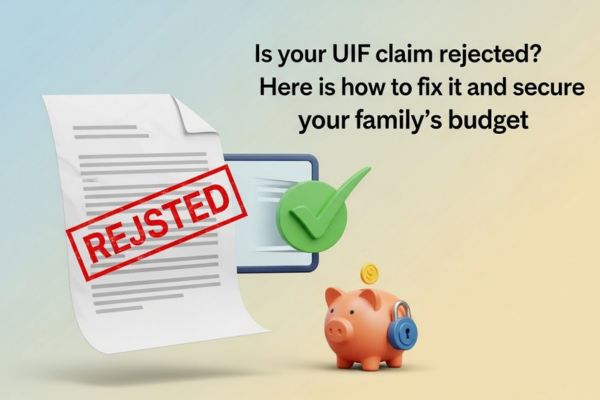
Is your UIF claim rejected? Here is how to fix it and secure your family’s budget.
Seeing a “Rejected” status after performing a UIF Status Check Online can feel like a major setback. It can seem as if your financial safety net has been cut off.
However, in most cases, a rejection is not final. It is often a request for additional information or a flag for a manual review. With the right approach, what appears to be a denial can become a successful claim.
Understanding why your claim was rejected is the first step toward resolving the issue and protecting your household finances.
📌 The Three Most Common Reasons for Rejection
Rejections usually occur due to system data issues, not personal mistakes. The most frequent causes include:
1. Reason for Termination Mismatch
If your employer submitted a UI-19 stating that you “Resigned” (Code 16) instead of “Retrenched” (Code 17), the system will automatically block the payout. The classification must align with UIF requirements, otherwise the claim cannot proceed.
2. Insufficient Credits
UIF calculates benefits based on accumulated work credits. If employment history from previous years is missing, the system may conclude you haven’t worked long enough to qualify, even if you are eligible.
3. Active on Another System
The database may incorrectly register you as receiving a salary or a conflicting state benefit. In such cases, the system blocks the payment until the conflict is resolved.
Remember: The system rejects data, not people. Identifying the reason allows you to target the solution effectively.
🛠 Alternative Steps if Your Claim Remains Rejected
If the standard fixes have not worked, these “Plan B” steps can help you move your claim forward:
1. Lodge a Formal Appeal (Notice of Appeal – NOA)
If the rejection is due to a policy disagreement or disputed classification, you have 90 days to submit a Notice of Appeal. Download Form UI-12 from the official UIF portal. The appeal moves your claim to the Regional Appeals Board, where a human committee—not the automated system—reviews your case.
2. Request a Manual Declaration Update
In some cases, the electronic system fails to detect your complete work history. Bringing UI-19 forms and salary slips from the last four years to a Labour Centre allows a consultant to perform a Manual Declaration Update. This can override a rejection due to “Insufficient Credits” and properly update your records.
3. Contact the Public Protector
If your claim has been rejected unfairly and appeals are ignored, the Office of the Public Protector can investigate administrative errors. They have the authority to intervene in cases where government processes are preventing payment.
4. Seek Legal Aid Support
If your employer is responsible for the rejection—such as refusing to submit your UI-19 forms—you can request assistance from Legal Aid. They can help draft formal demands and ensure employers comply with the Unemployment Insurance Act.
⚠️ The Time Trap Warning
Do not delay in responding to a rejected claim. The longer a rejection sits unresolved, the harder it becomes to restart the internal Paymaster processes. Claims not disputed within the legal timeframe may be archived, and work credits could be permanently lost.
Key point: An ignored rejection becomes a permanent loss.
🚀 Pro-Tip: Speak Directly to a Claims Officer
If repeated attempts fail, visit your nearest Labour Centre and request to speak specifically with a Claims Officer rather than a general clerk.
Claims Officers have manual override authority and can correct errors that the uFiling portal cannot resolve. This direct intervention often provides the fastest resolution for persistent rejections.
Conclusion
A “Rejected” status does not signal the end of your UIF claim. Most rejections are fixable through appeals, manual updates, or direct intervention.
By identifying the root cause, acting within legal deadlines, and using the correct escalation channels—including Labour Centres, the Public Protector, or Legal Aid—you can convert a technical “No” into a successful payout.
Being proactive, organized, and persistent is key. Understanding the system’s processes and knowing where to escalate allows you to protect your financial stability and recover the benefits you are entitled to.