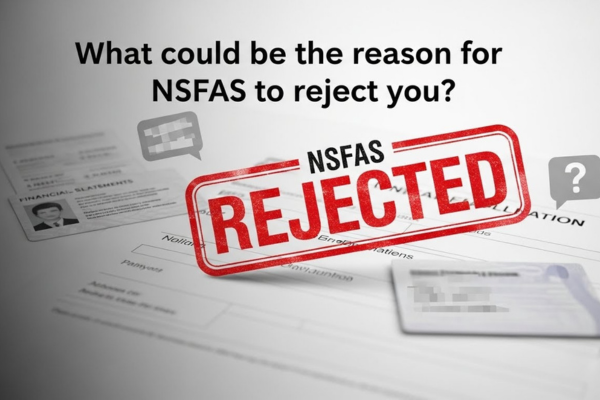
What could be the reason for NSFAS to reject you?
The National Student Financial Aid Scheme (NSFAS) utilizes an automated adjudication system to process millions of requests.
Rejections are typically the result of an applicant failing to meet the specific legislative or administrative criteria set by the Department of Higher Education and Training (DHET).
Understanding these factors is essential for students who may need to prepare a formal appeal or adjust their documentation for future cycles.
Rejections are categorized into financial, academic, and administrative barriers.
Step 1: Financial Eligibility and Income Thresholds
The most common reason for a rejection is exceeding the combined gross annual household income limit.
The scheme is designed specifically for students from low-income backgrounds, and the thresholds are strictly enforced through data sharing with the South African Revenue Service (SARS).
- Standard Threshold: A combined household income exceeding R350,000 per annum.
- Disability Threshold: A combined household income exceeding R600,000 per annum.
- Data Mismatches: If the income declared on the application does not match the records held by SARS or the Department of Social Development, the system may default to a rejection based on “Financial Ineligibility.”
Step 2: Academic Performance and the N+ Rule
The scheme does not only evaluate financial need; it also monitors academic progress to ensure the sustainable use of public funds.
The “N+ Rule” is the primary mechanism used for this evaluation.
- Definition of N+ Rule: “N” represents the minimum number of years required to complete a specific qualification. The “+” represents the additional years a student is permitted to remain funded (currently N+1 for most students).
- Exceeding N+: If a student has been registered at a public higher education institution for longer than the permitted period, even if they were not funded by the scheme during those years, they will be rejected.
- Academic Progression: Failure to pass a minimum percentage of course modules (typically 50%) in the previous academic year will lead to a rejection based on poor academic performance.
Step 3: Verification Failures with Third-Party Databases
The application process relies on the real-time synchronization of data between multiple government departments.
If the information provided cannot be verified against official state records, the application will be declined.
Common verification failures include:
- Home Affairs Mismatches: If the names or ID numbers provided do not match the records at the Department of Home Affairs (DHA).
- Citizenship Status: The bursary is restricted to South African citizens. Permanent residents or international students do not meet the legal criteria for this specific scheme.
- Existing Qualifications: Applicants who already hold a degree or a high-level qualification are generally ineligible for funding for a second undergraduate qualification.
Step 4: Administrative Errors and Incomplete Documentation
Many rejections are not based on the applicant’s actual circumstances, but rather on the failure to prove those circumstances through the correct administrative channels.
- Invalid Documents: Uploading documents that are expired, uncertified (where certification is required), or physically illegible.
- Missing Consent Forms: Failure to provide a signed consent form prevents the scheme from legally verifying the household income, resulting in a rejection because the financial status cannot be determined.
- Incorrect Institution Type: Applying for funding to attend a private college or university. The scheme only provides bursaries for the 26 public universities and 50 TVET colleges.
Step 5: The Procedure for Addressing Rejections (Appeals)
A rejection is not necessarily the final stage of the process. If an applicant believes the decision was made based on incorrect or outdated information, they have the right to lodge an appeal.
- Identify the Reason: Check the specific “Reason Code” provided on the myNSFAS portal.
- Gather Evidence: Obtain new documentation that directly addresses the reason for rejection (e.g., a new payslip showing a change in household income or an updated academic transcript).
- Submit within the Window: Appeals must be submitted via the portal within the designated timeframe (usually 30 days from the date of the rejection notice).
By understanding these technical boundaries, applicants can ensure their documentation is robust and their expectations are aligned with the scheme’s legislative mandate.